
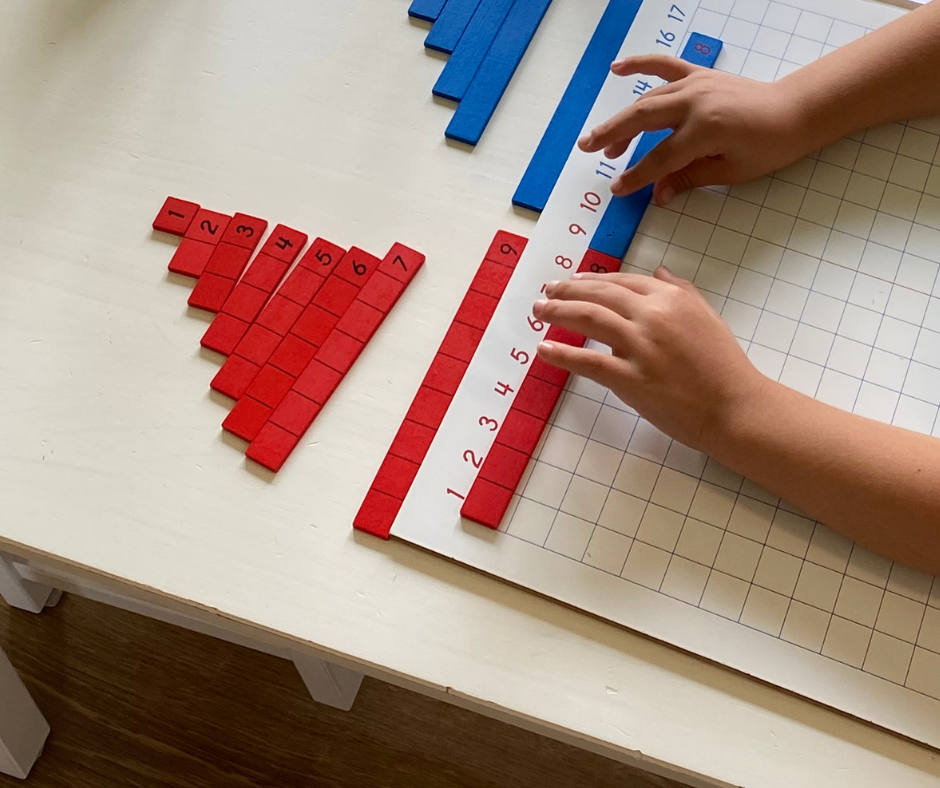
If you’ve ever watched a child using Montessori math materials, you’ve likely seen something remarkable: focus, independence, and genuine joy in learning. From golden bead units to fraction insets, Montessori math looks very different from traditional worksheets and memorization drills. But does it work? More importantly, why does it work?
Let’s explore the key principles behind Montessori math and the research-supported reasons it’s so effective.
1. Concrete Before Abstract: The Foundation of True Understanding
One of the most powerful aspects of Montessori math is its emphasis on hands-on, concrete learning. Instead of starting with symbols. Montessori guides children to physically manipulate beads, rods, and number tiles.
Why this matters:
Children naturally learn through movement and touch. By engaging the senses, Montessori materials turn math into something tangible. Concepts like place value, the decimal system, and fractions become understandable before they become symbolic.
The result: deeper comprehension and better long-term retention.
2. Self-Paced Learning Builds Confidence
In Montessori environment, children move at their own pace. They aren’t rushed through concepts before they’re ready, nor are they held back by a rigid curriculum schedule.
This approach helps children:
- Develop confidence in their math abilities
- Explore challenging material without fear
- Build mastery instead of memorizing steps
When math isn’t a race, children learn to love the process—not just the correct answer.
3. Materials That Make Abstract Ideas Make Sense
Some of the most iconic Montessori math tools—like the golden bead material—solve problems traditional education has struggled with for decades.
For example:
- The golden beads visually represent thousands, hundreds, tens, and units.
- Stamp game tiles transition children from hands-on materials to symbolic math.
- Fraction insets make equivalent fractions and operations intuitive.
These materials bridge the gap between doing and understanding, supporting children as they progress from concrete manipulation to mental computation.
4. Research Supports the Method
A growing body of research shows that Montessori students often perform as well as or better than their peers in math assessments. Studies have found Montessori-educated children demonstrate:
- Stronger mathematical reasoning
- Better problem-solving skills
- Greater independence and persistence
While results vary across schools and environments, the overall trend strongly supports the effectiveness of Montessori math pedagogy.
Montessori math is effective because it respects how children naturally learn. By offering concrete materials, space to explore, and a focus on mastery rather than memorization, it nurtures both competence and confidence.
The result?
Children who understand math deeply, enjoy the process, and build skills that last a lifetime.
We will be happy to help you!
Comments are closed